The world of specialty coffee involves a series of verifications from Geographical Indication (GI) and certifications to full grain traceability. However, when it comes to proving the quality of the beverage, it is the classification process that separates a commercial coffee from a specialty one.
Since 2026, the Brazilian Official Classification (COB) has included the “Specialty” category, reserved for coffees that achieve 82 points or more in sensory evaluation. The score is not merely symbolic: it synthesizes precise physical and sensory attributes, evaluated by certified professionals at every stage of the supply chain.
The classification of specialty coffee begins before the bean even reaches the laboratory it begins in the field, with sample submission. When a producer wishes to market a lot, the first step is to send a representative sample to the grading department. This step must be carried out with care and precision, as a poorly collected sample invalidates the entire analysis.
The standard protocol covers these stages:
Physical classification: Identification of bean defects and external impurities
Screen size and color: Grain size and color tone, revealing processing history and drying quality
Moisture: A critical factor for preservation and roast uniformity
Sensory analysis (cupping): The final test, where aroma and flavor reveal the true identity of the beverage
These are defects that compromise the integrity of the coffee bean itself altering its morphology, color, or structure.
These are defects that compromise the integrity of the coffee bean itself altering its morphology, color, or structure.
Black bean: Dark, opaque coloring. Caused by delayed harvesting or prolonged contact of the fruit with the soil, triggering unwanted fermentation.
Sour bean: Brown coloring in varying shades, the result of fermentation. Common causes: off-peak harvesting, contact with wet soil, and improper drying patio management.
Stinker: Shiny, wrinkled appearance with visible silver skin. Associated with drying at excessively high temperatures.
Insect-damaged bean: Small holes caused by pest infestation, with black or bluish spots from fungal development. Indicates phytosanitary control failure or poorly managed harvesting.
Shell bean: Shell-shaped morphology, with genetic or physiological origin.
Immature bean: Underripe, greenish coloring. The direct result of harvesting fruits still in the vegetative stage.
Broken bean: A fragment of a whole bean, generally caused by excessive drying that weakens the grain structure.
Inner shell : Underdeveloped bean resulting from the separation of interlocked grains, originating from the fertilization of two ovules in a single ovary chamber.
Withered bean: Incomplete formation, with low mass and a shriveled appearance.
Crushed bean: Physical deformation caused by animal or mechanical traction on the drying patio, or by improperly calibrated hulling equipment.
These are all materials foreign to the bean vegetable debris, seeds from other species, or unwanted physical matter in the lot. The most common include: sticks, stones, clods, husks, unhulled cherries, and what is known in Brazil as marinheiro a bean whose parchment layer was not fully removed during hulling, equivalent to the English term parchment bean.
The physical process follows a standardized protocol:
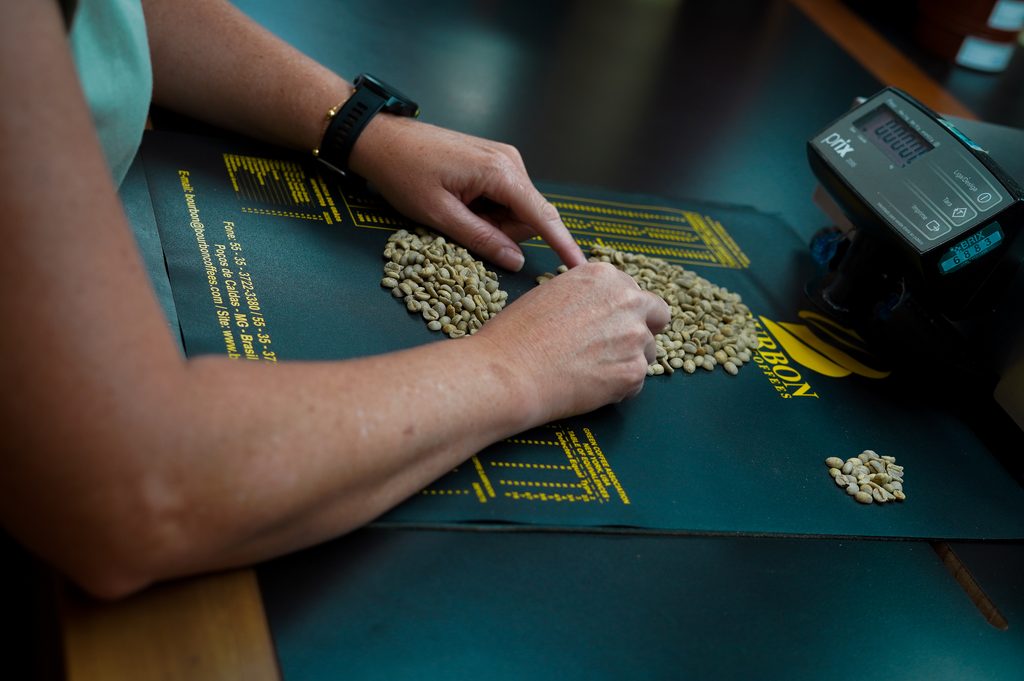
Visual sorting: on a black counting board, perfect beans are separated from defective ones (intrinsic) and from impurities (extrinsic)
Equivalence conversion: the quantity of each defect type is converted into defect points using the COB table (e.g.: 1 black bean = 1 defect point; 5 immature or broken beans = 1 defect point)
Type definition: the total defect score determines the coffee’s grade, on a scale ranging from Type 2 (4 defects) to Type 8 (360 defects)
The grade defines the commercial positioning of the bag and is a determining factor for access to the specialty coffee market.
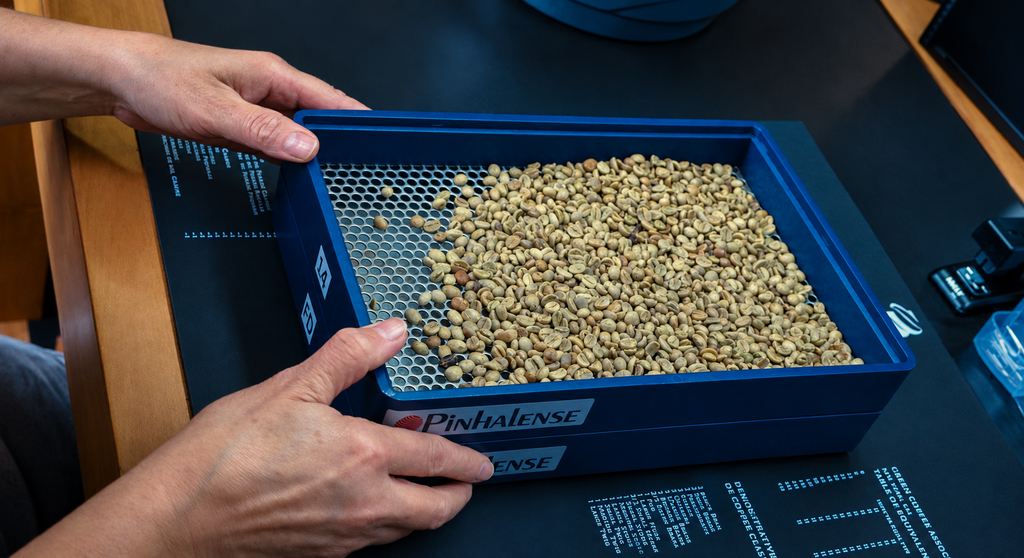
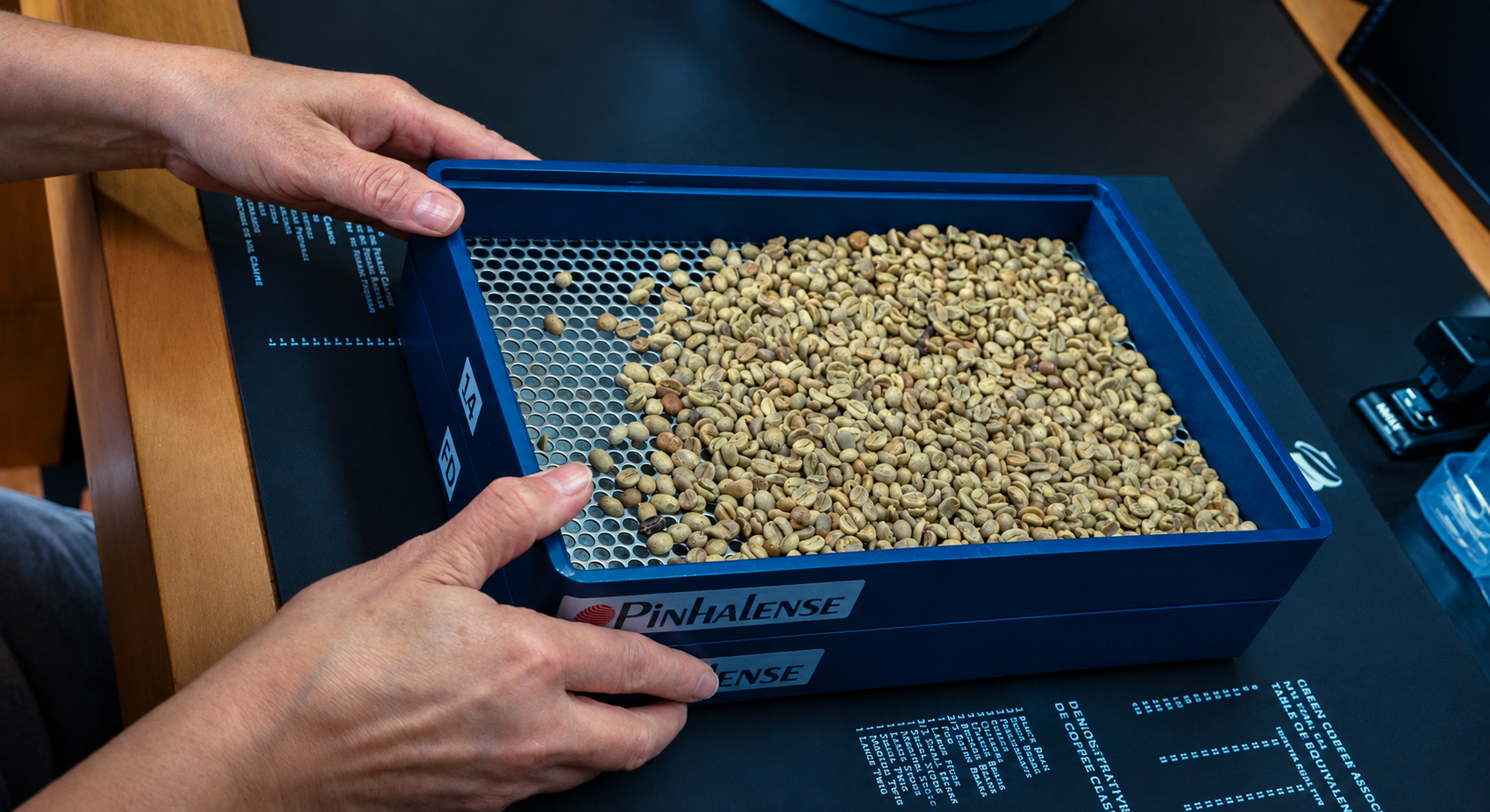
Screen analysis determines the size and shape of the beans in a lot a factor directly linked to roast uniformity and sensory consistency.
Numbered screens are used with two types of openings:
Round holes: for flat beans (screens No. 10 to 20)
Oblong/slot holes: for peaberry (screens No. 8 to 13)
The screens are stacked in decreasing order (highest-numbered screen on top), with a bottom receiver tray to collect beans that pass through the smaller screens. The sample used is 100 grams of sorted green coffee clean, free of defects or impurities to ensure accuracy in the screen reading.
The color of the beans reveals the processing history and aging degree of the coffee. Two main factors influence coloration: the post-harvest processing method and drying conditions.
Coffees processed by the wet (washed) process present blue-green or cane-green tones, with a well-defined silver skin.
Coffees processed by the dry (natural) process vary between green, greenish, yellow, yellowish, straw, slate, muddy, and off-white. The colors green and greenish generally indicate well-conducted drying and are associated with higher-quality natural coffees.
The moisture percentage is a critical parameter for coffee preservation and roast uniformity. The roaster must know this data precisely before processing the lot variations outside the standard compromise the final result in the cup.
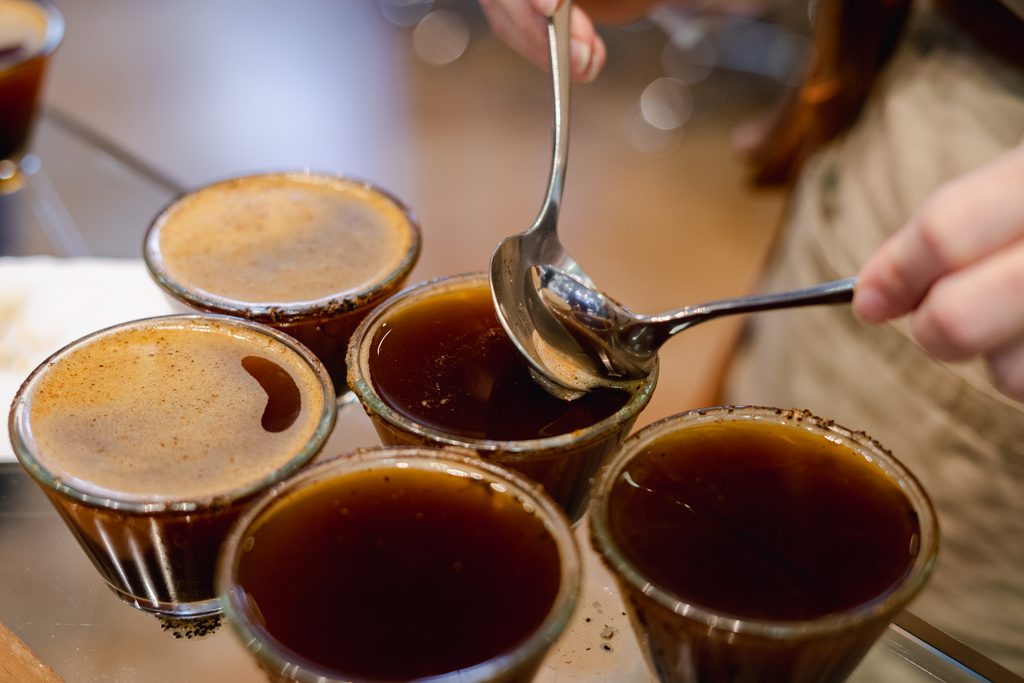
The final stage is the cup test. For this evaluation, the coffee receives a light roast specifically to avoid masking any flaws behind roasted or burnt notes, making every defect clearly perceptible in the cup.
For Arabica coffee, the result of this test classifies the beverage into two major groups: fine cups and rioy/phenolic cups.
Clean coffees, free of off-flavors. Ranked from sweetest and smoothest to most full-bodied and astringent:
Strictly soft: Top quality. Extremely smooth, sweet, and clean.
Soft: Very pleasant, sweet, and light.
Softish: Simpler, with mild sweetness and no harsh bitterness.
Hard : A stronger, dry, and astringent cup with a slight gripping mouthfeel. Despite the roughness, it is a clean coffee with no off-flavors.
Coffees that suffered problems, generally from poor fermentation or excess moisture. The terms rioy and phenolic refer, in practice, to a coffee carrying a medicinal or antiseptic taste — reminiscent of iodoform.
Riado A faint medicinal aftertaste.
Rio Strong, prominent medicinal flavor.
Rizona The most severe level. The chemical, medicinal taste is overwhelming and nearly undrinkable.
Classification is an essential process for attesting to the quality of coffee. It is what ensures producers receive fair recognition for their work and gives the buyer certainty that the coffee in the cup is the same coffee approved in the sample.