Coffee plant fertilization is a fundamental pillar not only for the development of a productive crop but also to ensure the final productivity and quality of the bean. However, for the investment in fertilizers to be truly efficient, guesswork must be replaced by strategic planning for a best practices for a crop yield.
To establish an accurate fertilization schedule tailored to the reality of each crop, the producer needs to master some essential steps. In this article, you will understand how to optimize your management through the following points:
The nutritional demand of the coffee plant varies according to its developmental stage. For example, a coffee plant in production has much higher nutritional requirements than a plant in the formation stage. Therefore, soil and leaf analyses are essential tools, as they allow for an accurate assessment of the nutritional needs of each coffee plantation.

According to the 5th Approximation Manual (CFSEMG), soil analysis requires strict criteria. The process consists of collecting 20 to 30 simple samples per plot, taken from the 0 to 20 cm depth layer. These subsamples are mixed to form a composite sample of about 500 g, representing a uniform area (e.g., 20 hectares), which will be sent to the laboratory for chemical evaluation.
Although soil sampling can be done at any time of the year, the manual highlights that it should be carried out well in advance of the planting or fertilization season. From the results of this analysis, the producer can accurately identify which nutrients are lacking or in excess in the crop.
Leaf analysis, on the other hand, complements this diagnosis by directly assessing the plant’s nutritional status. According to the Coffee Manual: Management of Coffee Plantations in Production (EMATER-MG / EMBRAPA CAFÉ), it is recommended that leaf collection be done between January and February, during the pinhead stage (grain filling), which represents the peak of nutrient absorption. Through it, it is possible to identify deficiencies or excesses even before visual symptoms appear in the crop.
Based on this information, it becomes possible to elaborate a more precise and efficient fertilization schedule. This planning organizes the application of nutrients throughout the crop cycle—usually divided into three or four applications—ensuring that the coffee plant receives the necessary elements at the right time, which contributes to better development, higher productivity, and bean quality.
There are several nutrients that the coffee plantation receives through fertilization. They are divided into macronutrients (required in larger quantities) and micronutrients (required in smaller quantities). It is crucial to highlight that, in agronomy, both are equally essential. The lack of a micronutrient like Boron can severely limit production, even if the plant has plenty of Nitrogen.
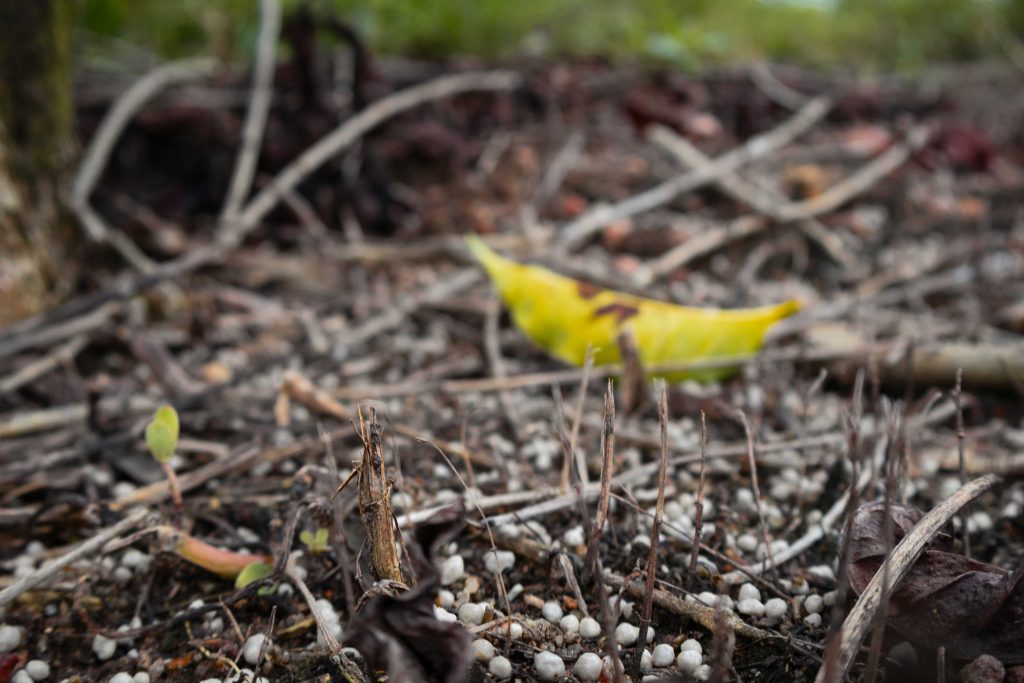
Check the function of each one in the table below:
| Nutrient Type | Nutrient | Main Function |
| Macronutrient | Nitrogen (N) | Vegetative growth |
| Macronutrient | Phosphorus (P) | Root development and flowering |
| Macronutrient | Potassium (K) | Grain filling and crop quality |
| Macronutrient | Calcium (Ca) | Cell structure and nutritional balance |
| Macronutrient | Magnesium (Mg) | Chlorophyll component and photosynthesis |
| Macronutrient | Sulfur (S) | Protein formation and metabolism |
| Micronutrient | Boron (B) | Flower and fruit formation |
| Micronutrient | Zinc (Zn) | Growth and hormone synthesis |
| Micronutrient | Copper (Cu) | Action in enzymes and metabolic processes |
| Micronutrient | Iron (Fe) | Chlorophyll formation |
| Micronutrient | Manganese (Mn) | Photosynthesis and enzymatic activation |
| Micronutrient | Molybdenum (Mo) | Nitrogen fixation and metabolism |
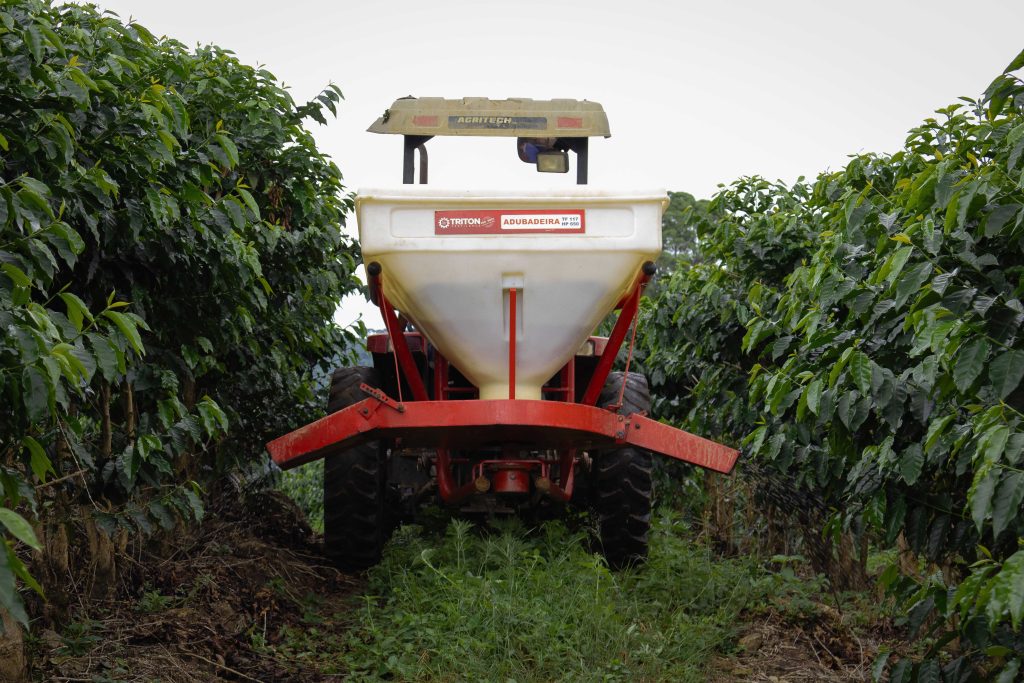
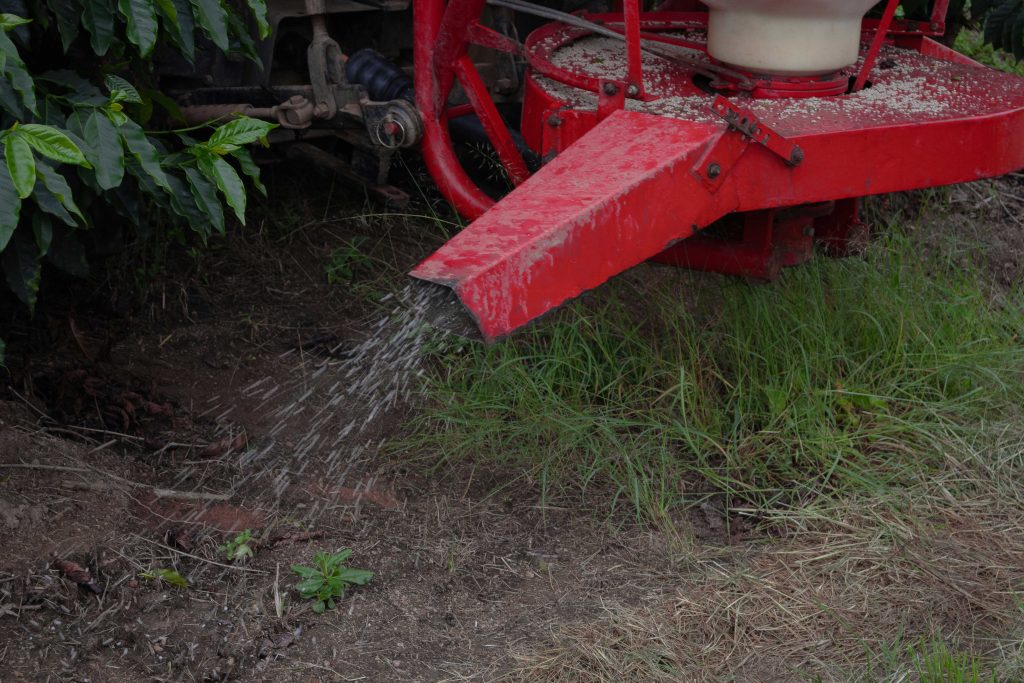
In practical field application, it is recommended that the fertilizer be distributed along the coffee planting line in the canopy projection. It is precisely in this region where most of the plant’s absorbing roots are concentrated, facilitating the rapid uptake of fertilizers.
The ideal time for fertilization is usually the period known as the ‘rainy season,’ which runs from September to March. With adequate water availability, the transport of nutrients from the soil to the coffee tree’s roots is enhanced, contributing to greater absorption efficiency by the plant.
Additionally to conventional application, fertigation stands out—a technique that uses the irrigation system’s own water to distribute fertilizers (mineral or organic). Nutrients are introduced into the hydraulic piping, and the schedule can be split into 2 to 4 applications per year, varying according to technical recommendations, the age of the crop, and soil and climate conditions.
Although as we have seen, coffee fertilization is far from being a ready-made recipe or as long as assumptions. Reaching the maximum productive potential and the best bean quality requires management and science. By integrating a well-executed soil analysis, strategic leaf analysis, and the balanced supply of macro and micronutrients, crop management ceases to be a cost and consolidates itself as a safe investment.